

For some veterans, the phrase “community care” can sound like a simple choice: see a doctor outside the VA and have the VA cover it. That is not quite how the system works. In May 2025, the Department of Veterans Affairs announced a change that removed an additional physician review from one community-care pathway, making the process faster for eligible veterans.
That distinction matters because the VA healthcare access rule change did not create unrestricted access to private healthcare. Eligibility, VA healthcare enrollment, the reason for the referral, and VA authorization still play a role. It also does not automatically change a veteran’s disability compensation or 100% permanent and total rating.
What changed with VA healthcare access in 2026?
The 2026 VA healthcare access rule change streamlines the “best medical interest” pathway for eligible VA-enrolled veterans seeking community care. Previously, the veteran and referring clinician could determine that outside care was appropriate, but a second VA physician review was required before the decision became final. That additional review step has been removed.
What the change actually does
The change comes from the Senator Elizabeth Dole 21st Century Veterans Healthcare and Benefits Improvement Act.
Before the change, a veteran and referring VA clinician could determine that receiving care from a community provider was in the veteran’s best medical interest. However, the decision required a second VA physician to review it before it became final [news.va.gov].
That additional review is no longer required.
In practical terms, this can reduce one layer of administrative review for veterans who already meet the requirements for community care under the best-medical-interest pathway. The VA described the change as a way to give eligible veterans faster access to community care.
It does not, however, mean the VA has removed community-care eligibility requirements.
A veteran cannot simply select any private doctor, receive treatment, and assume the VA will pay the bill. Community care remains tied to VA eligibility, authorization, and the applicable community-care rules [va.gov].
That is the most important point to take from the VA healthcare access rule change.
Can veterans get healthcare outside the VA?
Yes, eligible veterans can receive healthcare from VA-authorized community providers, but access is not automatic. Veterans generally need to be enrolled in or eligible for VA healthcare and meet at least one community-care eligibility condition. VA authorization or referral is generally required before receiving non-emergency community care.
Six situations can make you eligible for community care
The VA identifies six circumstances that may allow an eligible veteran to receive care through a community provider:
- The care is in your best medical interest.
- VA does not provide the service you need.
- You live in a state or territory without a full-service VA facility.
- VA cannot meet the applicable wait-time or drive-time standards.
- The VA service does not meet certain quality standards.
- You qualify under certain grandfathered Veterans Choice Program distance or location provisions.
The access standards are especially important because they use specific thresholds rather than a general rule about a VA facility being “too far away” or “too busy.”
For primary care, mental health, and non-institutional extended care, the applicable standards are:
- More than a 30-minute average drive time, or
- More than a 20-day wait time for an appointment.
For specialty care, the standards are:
- More than a 60-minute average drive time, or
- More than a 28-day wait time.
These standards apply to the service the veteran needs and the VA facility that provides that service. They are not simply a blanket distance requirement for every type of care.
Do you have to be enrolled in VA healthcare to use community care?
Community care is not a separate private-healthcare benefit that veterans can activate independently. Veterans generally need to be enrolled in or otherwise eligible for VA healthcare and then meet the requirements for community care. The VA must also evaluate and authorize the appropriate community-care pathway before non-emergency treatment is received.
What to check before asking VA for non-VA care
If you are considering community care, start with your VA healthcare status and annual physical checkups rather than scheduling an outside appointment first.
A practical sequence is:
- Check whether you are enrolled in VA healthcare.
- Confirm that VA can evaluate the care you need.
- Discuss your healthcare needs with your VA healthcare team.
- Ask whether one of the community-care eligibility conditions applies.
- Wait for the required referral or authorization before scheduling non-emergency community care.
If you still need to enroll, the process is separate from determining whether you qualify for community care. Veterans looking for information on how to enroll in VA healthcare can start with VA’s healthcare enrollment resources.
How do VA healthcare priority groups affect community care?
VA healthcare priority groups and community-care eligibility are two different parts of the system. VA places enrolled veterans into one of eight priority groups based on factors such as service history, disability rating, income, and other eligibility factors. Priority group placement can affect healthcare costs and copays, while community care has its own eligibility requirements.
Priority group does not automatically equal community-care eligibility
A veteran’s priority group can affect how much they pay for certain VA healthcare services. It does not, by itself, establish that the veteran can receive treatment from a community provider [va.gov].
That distinction is easy to miss when looking at VA healthcare benefits as one broad system.
Community-care eligibility instead focuses on circumstances such as:
- Whether the needed service is available through VA
- Whether VA can provide the care within applicable access standards
- Whether receiving outside care is in the veteran’s best medical interest
- Whether quality standards are met
- Whether another qualifying circumstance applies
In other words, being in a particular priority group does not automatically send a veteran into community care.
Does the 2026 VA healthcare rule change affect your VA benefits?
The community-care change concerns how eligible veterans may receive certain healthcare services outside VA facilities. It is not presented as a replacement for the VA disability benefits system. Using community care should not be treated as an automatic change to a veteran’s disability rating or compensation.
Community care and VA disability compensation are separate issues
This distinction becomes especially important for veterans with a 100% permanent and total (P&T) disability rating, which is separate from other VA disability benefits such as VA special monthly compensation.
The VA describes permanent and total disability as a disability rated 100% disabling and not expected to improve.
The community-care rule addresses where eligible healthcare can be provided. It does not establish a blanket rule changing disability ratings because a veteran receives care from a community provider.
That also means veterans should be cautious about claims that the new rule either protects or removes a disability rating automatically.
The safest way to separate the two issues is simple:
- Community care = healthcare access.
- Disability compensation = disability benefits and ratings.
The 2026 change discussed here concerns the first.
What does the VA healthcare access rule change NOT mean?
The rule change does not mean every veteran can choose any private doctor and have VA pay the bill. It does not eliminate VA healthcare enrollment requirements, community-care eligibility criteria, referrals, or authorization. It also does not establish that receiving community care automatically changes a veteran’s disability rating or 100% P&T status.
What veterans should not assume
The change does not mean:
- You can use any private healthcare provider you choose.
- VA healthcare is now available anywhere without restrictions.
- VA authorization is no longer required for community care.
- Every veteran automatically qualifies for non-VA care.
- Community care replaces VA healthcare.
- A veteran’s disability rating automatically changes because they receive community care.
The core change is much narrower: an additional physician review was removed from the best-medical-interest determination for eligible community-care cases.
That makes one part of the process more streamlined without turning VA healthcare into an unrestricted private insurance plan.
How do you know whether community care may be an option for you?
Community care may be an option if you are enrolled in or eligible for VA healthcare and your circumstances meet one of the applicable eligibility pathways. The key questions involve the service you need, whether VA can provide it, access standards, quality, medical interest, and other qualifying circumstances.
Can I Use Non-VA Healthcare? Decision Tree
1. Are you enrolled in VA healthcare or otherwise eligible to receive VA healthcare?
- No: Check VA healthcare eligibility and enrollment.
- Yes: Continue.
2. What type of care do you need?
- Primary care, mental health, or extended outpatient care
- Specialty care
- A service VA does not provide
- Other care requiring evaluation
3. Can your VA facility provide the service you need?
- Yes: Continue evaluating access.
- No: Community-care eligibility may apply.
4. Can VA meet the applicable access standard?
For primary care, mental health, and non-institutional extended care:
- 20-day wait-time standard
- 30-minute average drive-time standard
For specialty care:
- 28-day wait-time standard
- 60-minute average drive-time standard
5. Does another qualifying circumstance apply?
Consider:
- Best medical interest
- Quality standards
- No full-service VA facility
- Grandfathered distance provisions
What VA healthcare changes in 2026 – and what stays the same
The key 2026 change is the removal of an additional physician review in the best-medical-interest community-care pathway. The broader framework, however, remains (VA healthcare enrollment still matters, eligibility requirements still apply, and VA remains responsible for determining and authorizing eligible community care).
VA Healthcare Changes in 2026: What Changed vs. What Didn’t
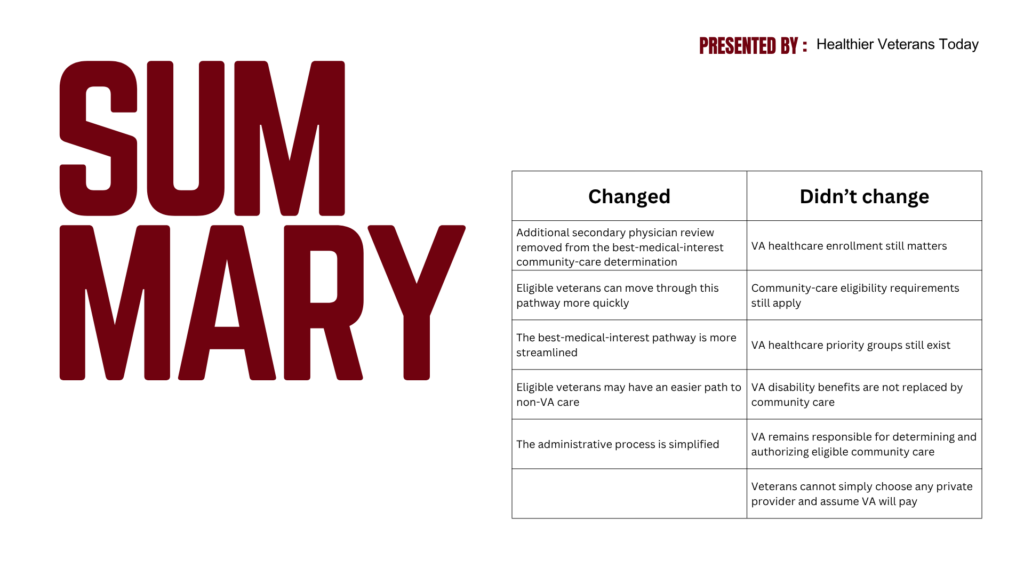
Important: This rule change does not mean every veteran can use any private provider at VA expense.
What this does NOT mean for 100% P&T: The community-care change is about access to healthcare, not a blanket change to disability ratings. A veteran should not interpret the rule itself as an automatic increase, decrease, or removal of a 100% permanent and total rating [thehill.com].
Frequently Asked Questions
What are the new VA changes in 2026?
The change discussed here removes an additional VA physician review from the best-medical-interest pathway for community care. For eligible veterans, this can streamline the process of receiving authorized care from a community provider. The other community-care eligibility requirements remain in place.
What is the new rule for veterans?
The rule change concerns access to community care. When an eligible VA-enrolled veteran and referring clinician determine that community care is in the veteran’s best medical interest, the previous additional physician review is no longer required before that determination can become final.
Can I lose my 100% permanent and total VA disability?
The community-care rule itself is not a rule that removes 100% permanent and total disability ratings. Community-care access and disability ratings are separate issues. However, the rule does not establish an absolute guarantee about every possible future action involving a disability rating, so rating questions should be addressed through the appropriate VA benefits channels.
Conclusion: Start with the question that matters
If you are asking, “Can I get this care outside the VA?” use the Can I Use Non-VA Healthcare? Decision Tree to work through the relevant questions. Then, if the result indicates that community care may apply, speak with your VA healthcare team about your situation and the appropriate referral or authorization.
For veterans who have not yet enrolled, VA healthcare enrollment should be addressed first. An enrollment question is different from a community-care eligibility question, even though the two are connected.
The VA healthcare access rule change is significant because it removes an extra step for an eligible pathway. It is not a wholesale change from VA healthcare to unrestricted private healthcare. That distinction can save veterans from making an appointment outside VA, assuming the VA will cover it, and discovering later that the required authorization was never in place.
For official information, veterans can also refer to the VA’s community care guidance and the VA announcement describing the change.